
 日本語
日本語 English
 中文 (中国)
Basic Process
-
Treatment temperature: typically in the range of 750–880 °C (lower than Carburizing: 900–950 °C).
-
Diffusion atmosphere: a carbon-rich gas mixture (CO, CH₄, or modified natural gas) combined with NH₃ as the nitrogen source.
-
Diffusion mechanism:
-
Carbon diffuses into the austenite lattice → surface enrichment with carbon.
-
Nitrogen dissociates from NH₃ → atomic nitrogen diffuses simultaneously, partly dissolving in austenite, and partly forming nitrides/carbonitrides (Fe₃(C,N)).
-
-
Quenching: usually oil, water, or high-pressure gas quenching → transforms the C+N enriched austenite surface into supersaturated hard martensite.
Characteristics & Applications
-
Case characteristics:
-
Shallower case depth compared to carburizing (typically 0.1–1.25 mm).
-
High surface hardness (55–62 HRC), with improved tempering resistance.
-
Nitrogen addition enhances wear resistance, fatigue strength, and reduces distortion during quenching.
-
-
Advantages:
-
Shorter processing time compared to carburizing.
-
Minimal dimensional distortion.
-
Effective for low-carbon and low-alloy steels.
-
Lower cost compared to deep carburizing.
-
-
Limitations:
-
Thin case layer, not suitable for components requiring deep wear resistance.
-
More difficult to control case uniformity in complex-shaped parts.
-
-
Typical applications:
-
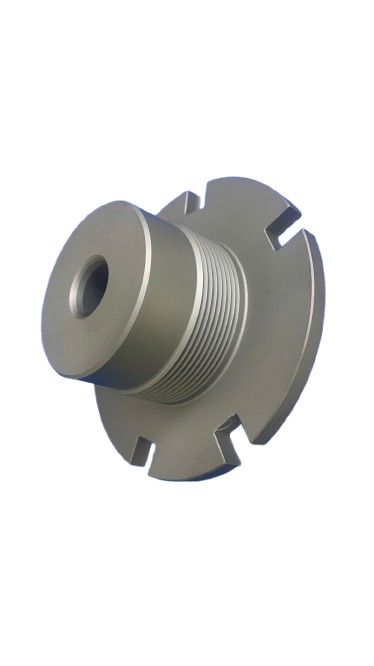
Small gears, shafts, pins, and bolts subjected to fatigue loading.
-
Automotive and motorcycle components (camshafts, piston pins, gears, shafts).
-
Small mechanical tools requiring wear resistance and high fatigue strength.
-


Đánh giá
Chưa có đánh giá nào.